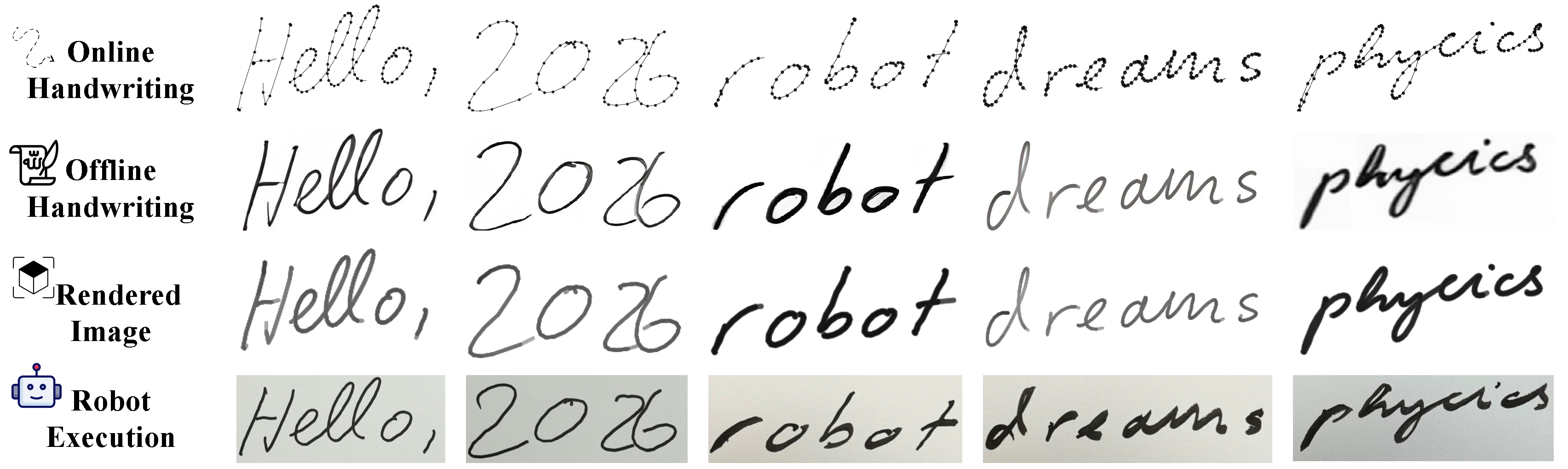
We integrate online and offline handwriting generation into a unified, physics-based differentiable rendering framework. By disentangling brush dynamics from pen trajectories, our approach enables highly controllable and realistic stylistic synthesis.
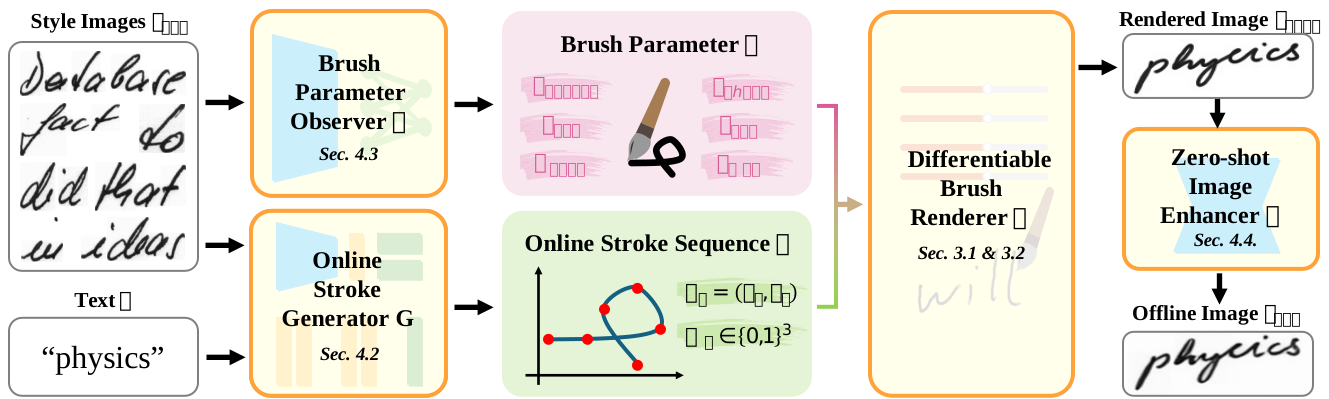
Fig. 1. Overview of the proposed joint online-offline handwriting framework.
Six physically-interpretable parameters θ = { wbase, kspread, ρink, σsharp, pmin, pmax } control brush footprint geometry, ink transfer, and stroke composition, all differentiable.
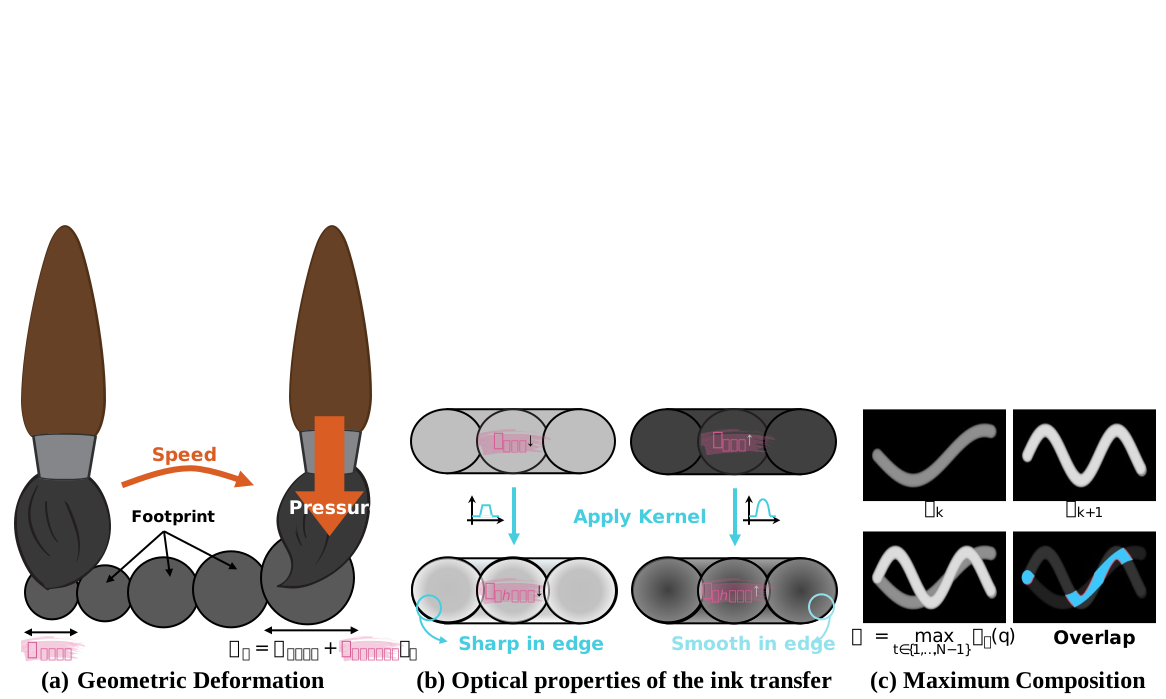
Fig. 2. Conceptual overview of the proposed brush model.
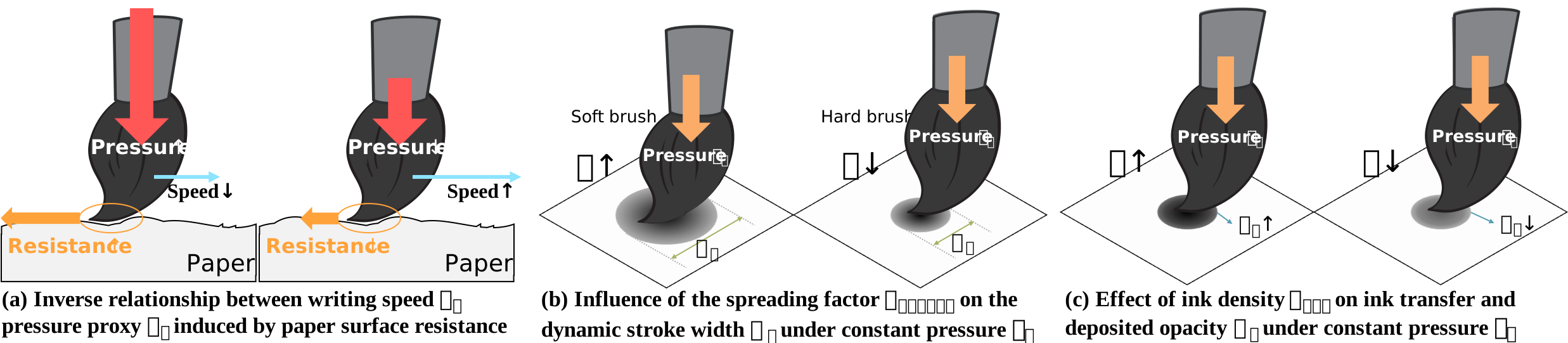
Fig. 3. Effect of brush parameters.
Using our renderer, we build a synthetic paired dataset Dsyn from existing online corpora (IAM-OnDB, CASIA-OLHWDB), composited onto diverse real-world backgrounds.


Fig. 4. Paired samples generated by our differentiable renderer, with diverse backgrounds, styles, and word lengths.
Combining our differentiable renderer with existing offline baselines (DiffPen, One-DM, Emuru, VATr++) improves both structural consistency and visual realism.
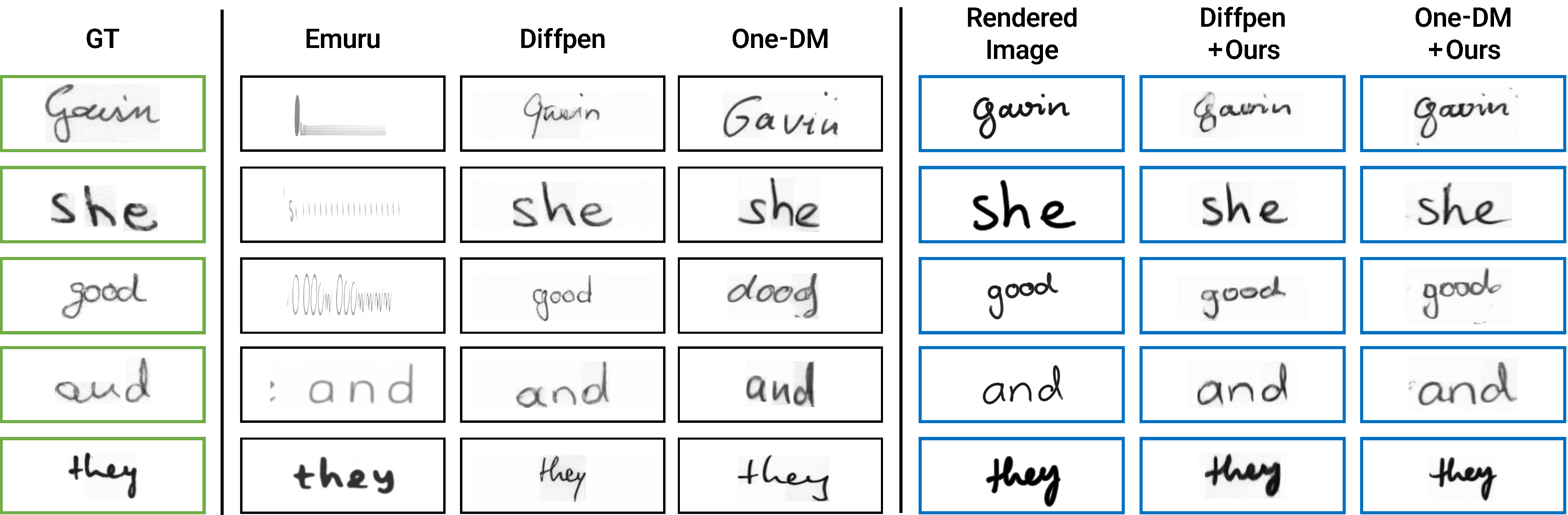
Fig. 5. Qualitative comparison of offline handwriting generation results.
Predicted stroke trajectories and brush parameters are executed on a Ufactory Lite 6 robot: the (x, y) path drives horizontal motion, and the pressure proxy modulates the vertical position z.
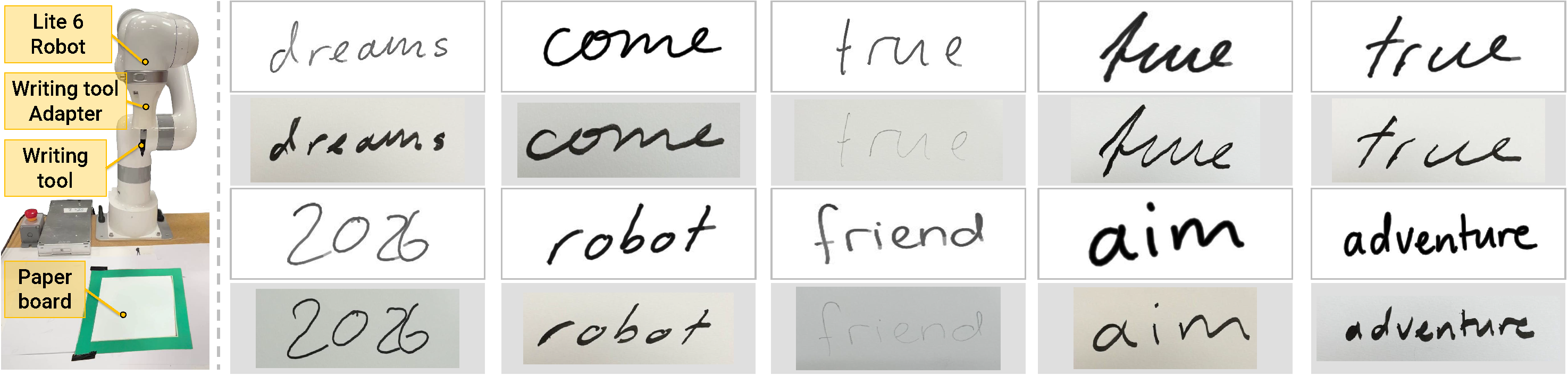
Fig. 6. Robot writing execution results.
Fig. 7. Robot writing demonstrations.
Word-level trajectories compose into sentences via fixed spatial offsets, scalable to both offline generation and robotic execution.
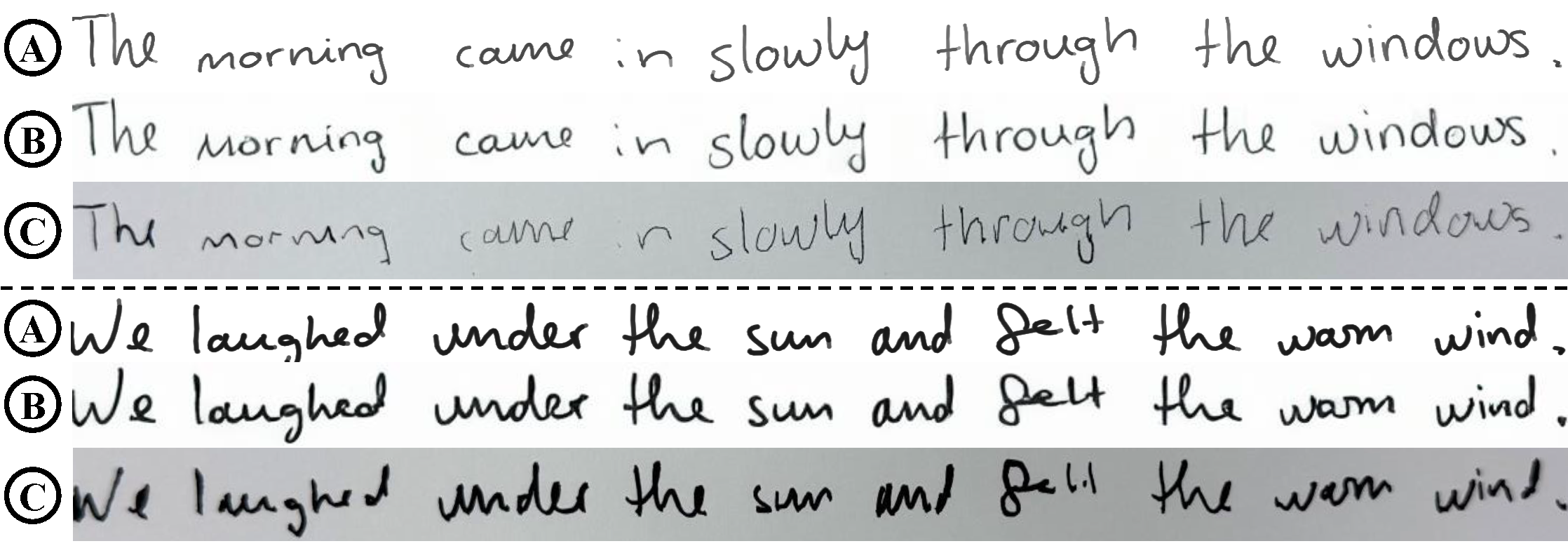
Fig. 8. Sentence-level application. (A) rendered image, (B) offline image, (C) robot execution results.
@inproceedings{park2026onoff,
  title     = {OnOff: Bridging Online and Offline Handwriting via Differentiable Physical Rendering},
  author    = {Park, Seonmi and Shin, Seunghyun and Misra, Vihaan and Shin, Dongmin
               and Shin, Ukcheol and Oh, Jean and Jeon, Hae-Gon},
  booktitle = {European Conference on Computer Vision (ECCV)},
  year      = {2026}
}